Know About In-Text Citation
Writing is an integral part of any academic project. In academic writing, referencing remains essential because it supports the text’s main content and reflects the academic writer’s or researcher’s research effort and credibility. When we refer to the source from which we are writing within the text itself, it is called an in-text citation, and it remains an essential component of an academic project. Reputed names in the Academic Writing service or assignment writing service can categorically explain how such referencing is crucial. Learn How In-Text Citations Help Avoid Plagiarism.
An in-text citation is a brief reference, not the full form of the document’s references, and it is not placed at the end of the paper or research article. Therefore, an in-text citation is brief and to the point, but it also reveals the exact source from which the reference was taken among the various other sources. An individual in the pursuit of academic research must understand the know-how of in-text citations. Step-by-step in-text citation for eBook writers.
They must understand the vital factors, as these are essential for understanding the sources and contexts in which a writer writes a particular research article. That is why every academic project provides in-text citations. Availing of academic writing services, mostly literature Review Writing solutions from reputed companies like SEO Content India, will undoubtedly help you with your complete need fulfillment—your academic writing along with the necessary references and citations.
You may Also Like: Why to opt for Help with MBA Assignment from India?
In academic writing, references are essential because they allow researchers to attribute and acknowledge the sources they use. For any research work or academic writing, a literature review is a crucial component. Whenever we use some literature as part of our research, we must give sufficient evidence of its correct use in that particular context. This is where citations and references come in.
Because references appear at the end of the research, in-text citations become vital for researchers. When experts read our research project, they should get the exact impression of what it conveys—the precise source of a particular argument or the literature used to make the assertion right within the text itself.
Examples of In-Text Citation
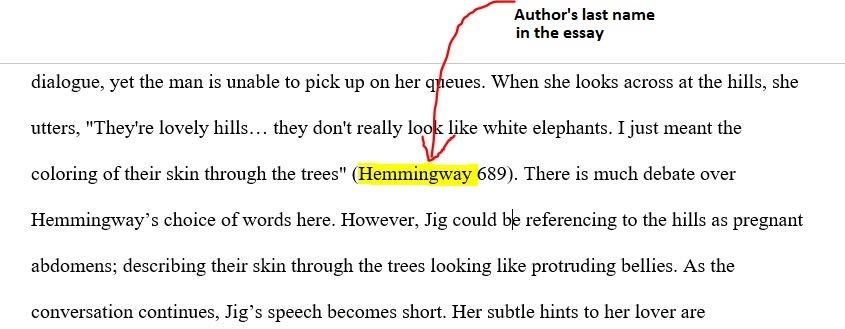 Source- roughwritersguide.pressbooks.com
For example, suppose I am arguing against private property and want to support it with relevant literature. In that case, I might use Karl Marx’s words in this context. Here, I would not mention Marx at the end; instead, I would use his comments in the context of my argument.
Therefore, I need to provide the citation within the text from which I am citing Marx’s words. This adds due weight to my comments or argument, as Marx’s views support it. In-text citations acknowledge and attribute sources and show the writer’s or academic researcher’s honesty.
Here we enlist how in-text citations can prove helpful in multiple ways:
Fact-Checking Tool: One reason citations remain useful is that they serve as a fact-checking tool and help you check whether similar arguments appear in other contexts. They help identify the exact source of an inference in an academic research document. They also add accuracy to your work and allow double-checking to strengthen its authenticity. Furthermore, they help you identify other research similar to the cited work. A reader can research the topic using multiple references cited in the text.
Helps in Understanding Research Patterns: In-text citations also help you understand research patterns and their relevance in contexts that may be similar to or different from what the particular researcher uses. This means readers can use references to understand a specific topic or apply them in a different context. When one researcher uses a detailed source, other researchers reading their work can also know about the relevant literature used in a different context.
Detailing Ability of Researcher: When you are on the verge of polishing yourself as a researcher and striving to avoid at least ten most common research paper writing mistakes, you will come to know how in-text referencing plays a vital role. Remember that proper citation helps you demonstrate your attention to detail, as useful research always involves the minutest details.
Whenever the writer uses a particular style of citation that mentions the page numbers, the author’s name, the year of publication, the journal number, if the source is a specific journal, the place of publication, it shows his or her ability to enter precise details correctly. It also speaks to the precision and reliability of the research.
The Credibility of a Researcher: In-text citation is an attribution of a writer’s work or a fellow researcher that a writer provides within the text. It shows the writer’s ability to acknowledge and recognize someone else’s work, which also adds to the quality of previous research. The ability to properly recognize another researcher’s work also adds to your credibility as a researcher or even if you are aspiring to be one.
When reflected in academic writing, what USC University of Southern California portrays—this quality helps draw other writers’ and researchers’ attention to your work and shows that your work is specific and precise. It also helps avoid generalizations and vague writing, further eliminating any chances of lacunae in the research you do.
Improves Scientific Orientation of Research: In-text citations are essential in scientific research projects, as scientific research has to be accurate and specific. Even in social science research, they remain relevant because they show a scientific orientation. As citations help readers or other researchers look for the exact sources referred to, they reflect your ability to highlight references exactly where you have used them.
Usually, a bibliography comes at the end, but in-text citations help readers understand the source precisely where it is used. It is the greatest advantage of such citations, as you do not have to refer to the end of the article or research paper to understand where the quote has been used.
Enhances Research Quality: Sometimes, even when the paper’s content is well articulated, the bibliography or in-text citations are inaccurate. It shows a degree of callousness on the part of the writer who may have written a very well-researched paper but fails to give exact sources that he or she has used or the ones referred to in the literature review. Want to know the difference between in-text and reference citations?
It calls into question the researcher’s credibility, as it shows that he or she is unwilling or unable to acknowledge other writers who have inspired him or her and helped him or her write the paper to accomplish the research project. Therefore, you must use correct citations in the right places to improve the quality of your research work. How to do in-text citations in APA?
Conclusion – Know About In-Text Citation
Whenever you are writing a research paper, you need to follow a specific format or style of citation. While writing, you must keep that style in mind to correctly cite the work of authors or other sources that you may have used. It adds value, quality, and credibility to your research and helps readers understand the importance of correct in-text citations.
There are many types of in-text citations in academic writing.
Frequently Asked Questions (FAQs) about Why In-Text Citation is an Essential Component
Q: What does “In-Text Citation APA” mean?
A: A good academic piece consists of in-depth research and references. It builds credibility in your work, considering the amount of research. So, what are in-text citations? An in-text citation in APA is included in an academic piece as a reference to the author you have mentioned as research material. The basics of in-text citation are maintaining transparency and giving the author due credit. Moreover, it helps researchers locate the original material you refer to. APA guidelines provide the map to find it.
Q: What is APA in-text citation for multiple authors?
A: APA in-text citation of multiple authors refers to the number of authors. If you follow APA 7th edition guidelines, in-text citations for 2 or more authors use the standard format. When citing up to two authors, the guidelines require including both names and the year of publication. In cases of three or more authors, adding one is sufficient, and the citation can be followed by “et al.,” and the year of publication.
Q: What are some benefits and examples of in-text citations in APA?
A: In-text citations are a must for every academic work. Adding these to your content has some benefits that help it stand out. Firstly, in-text citations verify your facts. They build transparency and can help readers understand your viewpoint. As a result, readers are more likely to see your material as a reliable source. Therefore, it is recommended to use in-text citations in your work to improve quality and showcase a well-articulated piece. Speaking of in-text citation examples, they are easy enough and can give you a comprehensive idea of how to write your own for two authors—(Layla & Kenneth, 2021). However, for more than two authors, use “et al.” Example—(Layla et al., 2021).
Q: Do in-text citations make your academic work reliable?
A: Definitely! In-text citations can give you an edge and benefit you in more ways than one. Academic articles and papers are considered to be a serious matter. They are used for further research, teaching, and more. Claims in academic papers must be supported by scientific evidence. In-text citations show reliability in your work. They reflect the research done and give credit to the original author. Readers can use in-text citations to verify the facts, use the original reference to apply to personal research, and further contribute to the academic field. Do you need academic writing tips?
Q: Is it mandatory to add in-text citations to academic work?
A: The simple answer is – yes, you must add in-text citations to your work. This is important because it credits all the sources used to create the academic piece. It provides mutual benefits. While the original author gets credit for his or her research that is now being used further, it also sorts out any issues arising from plagiarism for you. In-text citations must be added to uphold the principle of honor. Learn how to write an abstract for a thesis or dissertation.