Drafting Support for Conference Papers at India’s Institutions of Eminence
Do you need Drafting Support for Conference Papers at India’s Institutions of Eminence? Any academician will confirm that conference deadlines often arrive before the paper is ready. Most researchers feel the same way. The experiments are done, the datasets are ready, the argument is clear in one’s head, and yet three weeks before submission, the manuscript is still a set of notes and half-written sections. That is where a haphazard situation leaves one nowhere. In many institutions, researchers face a common situation where their expectations for paper publication fall short because of limited visibility and related gaps. The most common issue keeping them stuck is the gap between finished and unfinished research, as they don’t complete their work for many known and unknown reasons, costing time and resources.
Drafting support for conference papers in India
While such situations arise, the researchers, including faculty, postdoctoral fellows, and doctoral scholars, feel overburdened. On various occasions, they miss deadlines, causing them to fail to present research at the conferences they consider best. They may have an exceptional research idea, but mismanagement keeps them from submitting on time. Often, such scenarios create chaos for them. Therefore, students and researchers need drafting support for conference papers in India.
The reputed institutions have greater academic and administrative freedom. For public institutions, additional funding smooths things over. Ironically, this leverage also creates difficulties for researchers, with increased scrutiny and stricter criteria. From keenly focused, minutely observed research output to thorough assessment of citations and international collaboration, all factors are considered. Therefore, institutions evaluate conference papers against these criteria for genuine inclusion.
In Computer Science, Engineering, and parts of the Social Sciences, a paper at a well-regarded conference should count for as much as a journal paper, and often more. Conference proceedings indexed in Scopus or Web of Science are a remarkable success and an advantage for researchers, as they become part of institutional records. Furthermore, an effective presentation can lead to collaboration opportunities or even inclusion in special issues of reputable journals, offering a new kind of leverage. Our common services include research paper publication support, Journal paper publication support, Scopus Publication, etc.
Likewise, a rejected or weakly written paper misses its chance. It rarely comes back in the same form, and the researchers fail to gain recognition. With the next cycle a year away and someone else likely to have published a similar result by then, the chances become bleak. So, people need Drafting Support for Conference Papers at India’s Institutions of Eminence.
Therefore, researchers should focus on a well-researched article that best suits the conference’s needs. A relevant study with a timely assessment of the subject is an ideal choice for acceptance, as its scope for use in teaching and further research makes it more relevant. Such research also plays a pivotal role in helping supervise future students at varied levels and stages.
Related: Writing Research Papers without Plagiarism Issues
What Conference Reviewers Often Look for?
 Drafting support for conference papers in India
Conference reviews are comparatively quicker and less forgiving than journal reviews. A reviewer might have eight or ten papers to review in a fortnight while also meeting other deadlines. They therefore form an early opinion of everything—say, from the abstract to the introduction and don’t even share the problems solved with the researchers. Their remarks, including why they matter, can make the rest of the paper read as if it’s looking for reasons to confirm their first impression and more.
Several issues come up in reviewer comments and get highlighted. These range from specific contributions to unclear research and gaps that need addressing. Usually, experienced researchers know their topics thoroughly, especially the unique features of the paper they are drafting, and ensure they include all necessary details while cutting unnecessary vagueness.
At times, researchers also fail to convey the distinct aspects clearly, making this a weak point in a paper drafted in a hurry. Examples include burying something in the fourth paragraph of an introduction or spreading it thinly across the results, and much more that requires thorough analysis. Ultimately, the paper does not fit the call. Each conference track has a defined scope, and the reviewers always notice when a submission has been lightly reworked from a paper meant for somewhere else.
Related work reads as a list rather than an argument. Citing the maximum number of papers isn’t enough to convince a conference reviewer that you’ve thoroughly studied them and that your work is authentic, rigorous research. What remains crucial is showing that your research aligns with them and fits best by filling gaps and removing issues that could weaken the research. The page limit has been met by cutting the wrong things. The methods are compressed to the point that they cannot be reproduced, while the background section remains long. These issues are numerous and must be addressed.
The language further slows the reader down. Many excellent researchers in India write in English as a second or third language. Reviewers shouldn’t penalize that. And the better ones don’t. For example, if a sentence must be read twice, it can cost a reviewer enough time. If the entire paper is filled with sentences that wear down a reviewer’s patience, it can lead to rejection. Many such issues—small or large—affect the research quality parameter. Each one can play a major role in a paper’s rejection; therefore, a researcher must focus on every aspect.
Where does conference paper drafting support Fit?
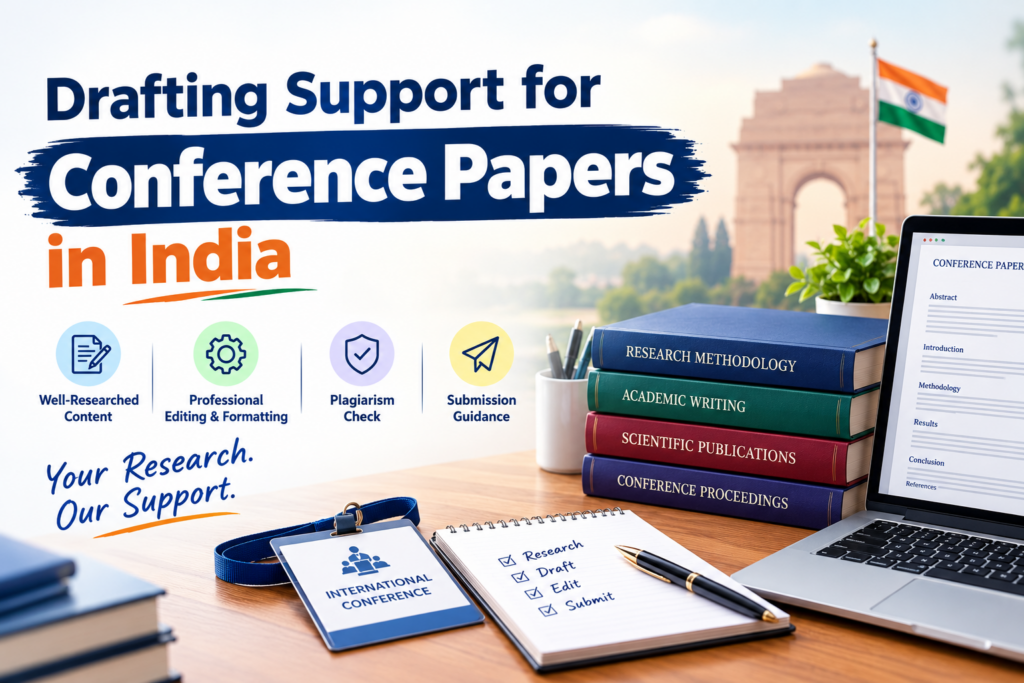
Professional assistance ranges from drafting support to extensive guidance on other aspects. SEO Content India is one such organization, with experts who offer tailored solutions. Experts bridge gaps from research through final submission. These solutions help make a task perfect in every respect. Usually, researchers bring incomplete tasks comprising a raw question, some collected data, and a rough analysis that require further polishing to an organized finding. Even the arguments require thorough polishing to ensure the paper comes up as a high-quality task.
They’re scattered, but they have ample potential to be combined into a research paper. The drafting team at this establishment supports shaping that material into a manuscript that meets global standards and that a reviewer can read quickly, judge fairly, and approve based on its depth and quality.
The work usually begins with a close reading of the call for papers and the target track. A surprising number of papers go out without anyone checking the scope statement line by line or looking at what the conference accepted in the previous two years. The reading determines how to frame the contribution.
Experts develop a proper paper structure using the researcher’s materials, while adding additional input. Usually, they include lab notes, group meeting slides, internal reports, thesis chapters, and much more that can prove to be the best assets to redevelop a research paper. In doing so, the professional works alongside the author to clarify the paper’s primary claim and the evidence behind it, turning it into a polished research work. The purpose remains focused on the different sections that must align with the defined conference format while giving the paper its final shape.
The experts ensure that all drafting and revision procedures follow multiple rounds and actively involve the author, making it a collective effort. The focus remains on writing and rewriting sections for maximum clarity. Furthermore, the related work is reorganized to better explain the gap the paper addresses.
From framing the abstract to ensuring compliance with IEEE, ACM, and Springer (LNCS (or other)), these steps are necessary. Focus on referencing style, citations, and figure resolution is equally crucial. They also ensure proper anonymization for double-blind review and related requirements. Experts also stay focused on structural aspects, from pagination limits to word count. These small factors matter because ignoring them can lead to a paper’s desk rejection/acceptance for further processing. Experts therefore consider all these elements.
At SEO Content India, support continues after the reviews arrive. If a paper is accepted with revisions, or rejected with comments worth acting on, the response letter and revised version are often harder to write than the original. So, help at this stage can mean the difference between a paper resubmitted promptly and one that isn’t.
Conference paper writing services in India
Researchers seeking expert help with writing and revising research must ask themselves and the parties offering their assistance whether such added effort will violate the institution’s integrity or the integrity they represent. It does not, as the boundaries for the assistance used are clear. Language editing and structural support are common nowadays. Indeed, several prestigious academic publishing companies encourage such additional services to improve the clarity of research. That is why reputable publishers often encourage and recommend professional editing services that researchers can use. Many even offer these services to make the task easier for writers.
SEO Content India’s approach focuses on the first kind of help and avoids the second. Researchers provide detailed research that needs fine-tuning. Experts on the drafting team never focus on producing results or fabricating citations. They also ensure they don’t submit research on anyone’s behalf; instead, they offer revisions at every stage, and the tweaked draft goes back to the author for review and assessment. The researcher decides what stays and what to remove as unnecessary. Wherever a conference or publisher advises authors to disclose writing or editorial assistance, one must do so without any hesitation. They can even acknowledge these teams for their assistance and support as needed.
Drafting support for conference papers in India
Early-career faculty are the most likely group to seek assistance. Because their academic profile often requires them to build a strong publication record as much as possible. Their primary roles include active involvement in teaching, along with support for various administrative activities. These activities remain important as they begin their careers. That is where they seek help with drafting and polishing research, since it is an integral part of the academic work they are expected to do.
Moreover, doctoral scholars preparing their first international submission are another group. They know their subject well but may not yet know the conventions of a particular venue, such as how much background a computer vision reviewer expects compared with a reviewer at an education conference.
Drafting Support for Conference Papers at India’s Institutions of Eminence
Senior researchers leading large funded projects often have more results than time to write them up and may need to submit several papers to different venues in the same season. In interdisciplinary teams, the problems they face often vary. Expert reviewers may read their research, so the draft needs a paradigm shift. At times, researchers returning after a career break or moving into a new area need expert support when they face time constraints and other challenges.
The bottom line is that anyone in academia knows drafting support exists, so reviewers can see the value on the first read. Researchers with an upcoming submission can reach out to SEO Content India to have the call for papers and their current draft reviewed, and to agree on a plan and timeline that suits the deadline. Let us know if you need drafting support for conference papers in India,
Also Read: Differences between Journal Papers and Research Papers